Station Eleven

Written by Emily St. John Mandel. Published by Alfred A. Knopf in 2014. 333 pages. Rating: 4/5.

Introduction:

Have you ever wondered what life would be like if you survived the apocalypse?  Would you be duking it out in the Thunderdome against some four-armed mutants?  Maybe you’d be scavenging in the ruins of an old Walmart for cans of Boston baked beans. 

In this Arthur C. Clarke Award winning novel Emily St. John Mandel imagines a world after a deadly virus called the Georgian Flu devastates the world. The virus kills 99% of the world’s population, leaving very few survivors to make sense of the world after. Mandel’s storytelling weaves forward and backwards in time to tell an engaging story about life, death, and what it means to live.

Brief Synopsis:

Station Eleven begins with a performance of King Lear in a Toronto theater.  Arthur Leander, an older A-list actor, plays the starring role. Midway through his rendition of King Lear, Arthur suffers a fatal heart attack.  Fellow actors are stunned, the audience confused, all the while the Georgian Flu descends upon the world. Within a month of Arthur’s death, the world has forever changed.. Nothing will be the same.

The story jumps ahead twenty years to the perspective of Kirsten Raymonde.  She was an eight year old child actor in that Toronto theater two decades ago.  Now she’s a twenty-eight year old badass a part of a group of traveling actors and musicians called The Traveling Symphony.  They migrate around the Great Lakes area of what used to be the United States performing Shakespeare. Their motto, “survival is insufficient,” is painted on the side of one of their caravan. It’s a quote from Star Trek: Voyager and strikes at the heart of this book.

After getting introduced to Kirsten and the other members of the Traveling Symphony we learn they are headed towards St. Deborah by the Water. There they hope to stage a performance of A Midsummer Night’s Dream and see some old friends they left there years ago.

However, once they get to town, everything is different. There’s less people, more armed guards, and many new faces. Their friends are also nowhere to be found.

After questioning some of the townsfolk who stayed, Kirsten and the symphony find out a cult took over the town months ago. A man proclaiming to be a prophet rules St. Deborah by gun and bullet. Those who don’t bend to his will are exiled, or worse. Luckily, the former symphony members fled town soon after the prophet arrived.

Rumor has it the former symphony members fled towards a city called The museum of Civilization. It’s a village built into an airport with a collection of pre-flu memorabilia. The Traveling Symphony head out towards the museum, but along the way find a stowaway in one of their wagons. This triggers a feud between the Traveling Symphony and the prophet. A manhunt ensures. The story goes on.

Thoughts:

Station Eleven is a complex book with a ton of layers. It makes it difficult to fully encapsulate the story and plot lines of the book because Mandel jumps around the timeline constantly. The book begins as the pandemic begins, then jumps twenty years in the future, then back twenty, then forward fifteen, etc…

The nonlinear storyline is a major plus because we get a better understanding of the main characters and how they react to the apocalypse. By the end of the book we get a history of all the major characters, like Arthur, Kirsten, the prophet, and more. The way everthing connects together by the end is satisfying.

If you’re looking for a book about the end of the world or how the world ends, look elsewhere. Unlike other apocalypse novels, such as Max Brooks’ World War Z, Station Eleven focuses on the aftermath of the apocalypse. In an NPR interview about her book, Mandel says:

“I very purposely set much of the action 15 and then 20 years after that flu pandemic. And the reason for that is that I feel that most dystopian fiction tends to dwell on that immediate aftermath of horror and mayhem. What I was really interested in and writing about was what’s the new culture and the new world that begins to emerge?” -Emily St. John Mandel

Survival Is Insufficient: ‘Station Eleven’ Preserves Art After The Apocalypse

The new culture that emerges after the end of the world circles around the idea that survival is insufficient. The Traveling Symphony are actors and musicians, jobs you might not think would be necessary for survival in a post-apocalyptic world.

But what kind of life would people be living without art? Without Music? Without some form of entertainment?

You might have an okay life, it might be a little boring. It might be nasty, brutish, and short. Without the arts life would be missing something important. Survival alone isn’t sufficient.

I thought this book was a wonderful read. If you’re into dystopian or post-apocalyptic novels, this book will be a nice change of pace for you. It subverted my expectations and I didn’t think I’d enjoy it as much as I did.

Do you have any books in mind that challenged your expectations? Any books that took a familiar genre and flipped it on its side? Let me know in the comments.
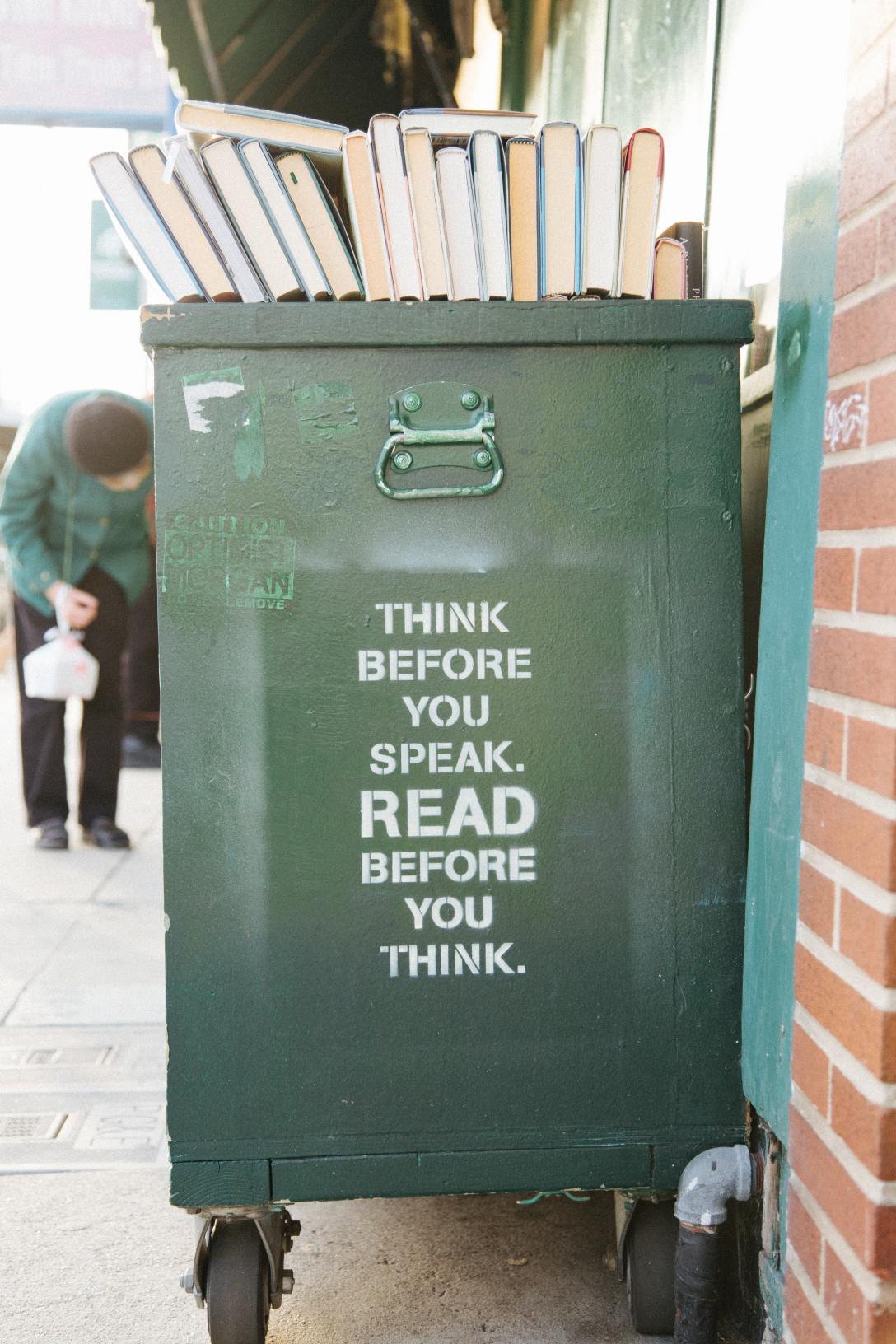
George Orwell’s Thoughts on the English Language

“War is peace

Freedom is slavery

Ignorance is strength”

1984 by George Orwell

George Orwell is the pen name of Eric Blair, an English writer known for his essays and books about totalitarian and authoritarian ideologies. Animal Farm and Nineteen Eighty-Four are his two best known novels and they both show the dangers of these despotic ideologies. Animal Farm is a critique of Soviet style communism. It shows how revolutionary ideas can be subverted to become the same as those the revolution sought to overthrow. However, I think Nineteen Eighty-Four has more of a cultural impact than his other novels. This book bringing such terms as “big brother,” “thought crime,” and “Orwellian” into public discourse used today.

But what exactly does it mean for something to be called Orwellian? What is doublespeak? Why does it all matter?

We think by using language to express ideas with ourselves in our minds or with others through speaking or writing. Orwell recognized the importance language had with our ability to think. By banning words or changing their meaning a government can affect the way people think about the world.

Orwell wrote an essay titled “Politics and the English Language” prior to Nineteen Eighty-Four where he discusses the state of modern English. He thinks that it is degrading to a point of meaninglessness. We use ready made phrases that think for us so we don’t have to. He describes how politics is giving the English language plastic surgery, to make the indefensible arguments more palatable.

I’m going to summarize his paper and connect it to the real world.

Language

Orwell begins by asserting modern English is facing a decline due to a self-perpetuating system of an effect turning into a cause. He gives the example of an alcoholic. They feel like a failure, so they drink and as a result of drinking too much, they fail even more. Likewise, “It (language) becomes ugly and inaccurate because our thoughts are foolish, but the slovenliness of our language makes it easier to have foolish thoughts” (L&P 128).

It is then a matter of habit the English Language is degrading into vagueness and incompetence. These bad habits stem from four different sources:

  1. Dying Metaphors. Metaphors are useful to convey imagery through words, but they can get overused and become stale. Metaphors can lose the power they once had and Orwell suggests that their meaning gets subverted, causing the original meaning to change. When the original meaning changes, the metaphor becomes senseless.
    • For example, when people say “I could care less” they intend to mean they do not care at all about X. Logically, they could care less, so that means they care to some degree about X. What they meant to say is “I couldn’t care less.” This second phrase is logically consistent, the speaker cares so little of X that they couldn’t care any less than they already do.
  2. Operators or Verbal False Limbs. This habit is one that I had in college, but it is essentially padding your writing to make it look distinguished. Its when you add phrases when a single word or two would do, simplicity is swapped for a facade of authority. Passive voice is chosen over active, drawing out the point and making it sound worse. Verbal false limbs make writing less concise, adds ambiguity, and looks ugly!
  3. Pretentious Diction. When writers use complex wording to convey ideas that could be expressed in simple words. It’s not that Orwell is against having a large vocabulary, his objection is when people use jargon to convey a false sense of authority. It’s like bluffing in a game of poker, you might play up your hand to trick your opponents into misplaying.
  4. Meaningless Words. A word is devoid of meaning when its meaning cannot be shown in a given context or when there is no clearly agreed upon definition. Meaningless words are consistently used in a dishonest way, especially in politics and news. Consider when MSNBC host Chris Matthews compared Bernie Sanders’ win in Nevada to the Nazi invasion of France. The meaning of Nazi is lessened when it is used to describe a Jewish democratic presidential candidate who participated in the democratic process. It’s absurd!

Here’s an example of the four above problems written out in the form Orwell warns us of:

The former passage is beautiful and well put, the latter is outright hard to read. Try asking a friend, “what subjective experience of contemporary phenomena have you undergone today?” They’ll give you the stink eye and walk away. Meaning is obfuscated and beauty is made ugly. Although this is just a “parody,” Orwell suggests that most other modern writers would come closer to the second passage than the first if we were to write about human fortune.

Orwell continues by claiming modern English is less concerned about the individual meaning of words and more concerned with piecing together prewritten phrases. It is much easier and quicker to write something you’ve heard before than to come up with something original. Relying on stitching together phrases instead of individual words comes at the cost of lost meaning that affects even our own understanding/meaning of what we are trying to say. We lessen our ability to think clearly and critically because we are limited to the meaning of phrases we know. Orwell suggest we can better become writers/thinkers if we ask ourselves these questions:

  1. “What am I trying to say?
  2. What words will express it?
  3. What idioms or image will make it clearer?
  4. Is this image fresh enough to have an effect?
  5. Could I put it more shortly?
  6. Have I said anything that is avoidable ugly” (L&P 135).

Orwell challenges modern writers to become more meticulous in our writing. Choose individual words over ready-made phrases and do so with intention.

Politics

The second half of the essay deals with how politics uses language to manipulate the public into complacency. He begins by writing, “political speech and writing are largely the defense of the indefensible” (L&P 136). A politician cannot say that we are going to bomb cities full of innocent civilians until the government surrenders. They will instead say they will begin a “strategic bombing campaign in key military installations.”

This is called “doublespeak” and it’s what Orwell warns us about in Nineteen Eighty-Four and in this essay. Doublespeak is how concentration camps become re-education centers. Dead and dying soldiers become casualties. Civilians killed in military operations become collateral damage. Doublespeak makes the worse arguments more persuasive and intends to stymie objections to the objectionable.

Why Does This All Matter?

I asked earlier what does it mean to be Orwellian, what is doublethink, and why does it all matter?

To be Orwellian is to be at odds with the truth. Disinformation and the denial of truth are two clear indications a free society might be falling towards an Orwellian state. “Language and Politics” shows the importance of language and how it can be used to trick people into supporting authoritarian and totalitarian ideologies.

This all matters because democracies like the United States are fragile. We were built upon principles of free speech which make us susceptible to Orwellian disinformation. Truth is twisted like a bread bag twist tie. You can see in the news. Lies and falsehoods become “alternate facts.” Truth isn’t truth and what’s “true” is drawn on party lines.

Orwell’s essay suggests that language ought to be defended by those writing it or speaking it. He leaves it up to the politician, the journalist, the pundits, etc… While it’s well intentioned to think that way and gets at the problem at the source, it neglects similar problems free speech entails.

Free speech neglects bad actors, people who are intentionally spreading disinformation. To tell these people to do better won’t correct their behavior. We are left to our own devices to differentiate disinformation from truth. We must approach news and politics with skepticism and question what we are told. Don’t rely on just one or two sources. Get your information from a variety of sources. It’s not feasible to put broad constraints on the freedom of speech, if we do we risk becoming a step closer towards authoritarianism.

I suggest thinking of your news sources as falling on a long line. At one end is very left-wing political biases, the other being right-wing biases. Try to get enough sources from both ends, the truth may lie somewhere in the middle.

Be weary of what you hear in the news. Much of what is reported based upon what’ll get the most clicks or attention. Watch for the language the news and politicians. What ideas might they be trying to sell you on? Look at how they phrase their statements, are they neglecting the truth? Are they pushing an agenda?

Sources and Links

  • Here is a .pdf of Orwell’s essay “Language and Politics.” It’s a short read, about fourteen pages, but it is poignant. It is worth your time. He provides numerous examples to better illustrate what he means by language is suffering degradation.
    • (I use L&P above to reference this article!)
  • TED-Ed makes great videos explaining different books and concepts found within them. I highly recommend their five minute video on what it means to be Orwellian.
  • Of course, I recommend Nineteen Eighty-Four. It’s a classic dystopian novel and I read it when I was a teenager. I fell in love with the book! It got me interested in literature and in politics.
  • Featured image credit: Photo by Kyle Glenn on Unsplash